
This video isn't posted in some attempt at blog irony. I just found this a few minutes ago on YouTube, and I liked the appropriate background music it provided as I shuffled around the house in bare feet, microwaving a cup of breathe easy tea and pulling my cat onto my lap.
31 December 2007

Fumer ou Ne Fumer Pas...

Mierd! Maintenant nous ne peux pas fumons dans Paris?
One of the most dramatic World News headlines I've scanned lately came from USA Today this morning: "Some Fear Smoking Ban Slices Soul of French Cafe" jumped out at me, waving it's beret desparately. Forget Pakistan's democracy panic. Forget the children of Iraq. Semding out an S.O.S., a smoke signal even, from the chimneys of every legendary haunt of aritsts, philosophers and visionaries in Parisian history. The very souls of the Cafe de Flore (mentioned in the article,) Les Deux Magots, Le Cafe de la Paix-- are being sliced by the knife of puritanical, judgemental, paranoid American bullshit policy! Vraiment?? Ah, le cigarette... Je sais, I know too well. It is a sad day when one must say goodbye to an old friend.
From the moment I shyly sniffed the paper, and gently set the filter on my bottom lip, I fell in love with cigarettes. Smoking was simply my favorite thing for years. My first taste was at the hands of two bosom girlfriends, who should know not to feel any guilt by now. I can see us at our half-moon shaped booth at the old Denny's, the one that now stands empty with niccotine stained upholstry and ceilings, so dark inside. But the light was hazy and comforting on summer nights with the three of us leaning into our coffee, laughing and chatting for hours, talking about sex like professionals, three 100 length cigarettes poised. I was a Marlboro Ultra-Lite smoker, for almost seven years.
Marlboro Ultra-Lights accompanied me to University in Iowa City, where I would skip class and brood in the dark, literary corners of The Tobacco Bowl, and underline fiercely throughout my signed copy of Alice Notley's Small Houses. With tears of frustration, I smoked madly outside the Foreign Language building after French exams. With my niccotine stained fingers trembling, I would silently translate fragments of my inner monologue into Francais, "Mierd, mierd, je suis tres stupide. Le monde est stupide," my inner frenchwoman dragging long and hard. It's true, I wanted to own that cigarette like I imagined the French owned their cigarettes, in some way simultaneously casual and passionate. Fumer comes along very early in verb conjugation, as every Elementary French student knows. I suppose I entertained the thought of being in one the great cafes one day, with perfect French and the perfect French cigarette.
But my smoking habit wasn't all romance and deep thought and pensive brow. I vivdly recall scrounging change in my dorm room late at night, searching all over my apartment for discarded butts in the ashtray, cigarettes I had foolishly gien up on mid-smoke and now- NOW needed just one drag from immediately. I would spend my last penny a pack of Basic Lights that cost less than $3 at the time, walking out in cool Spring school night to the Shell station for my fix. A pack a day: when I woke, after breakfast, before work, during work, after work, with a drink in hand-- many with a drink in hand.
So the smoking ban has reached the Parisian cafe. France's officials are joining in on the healtyh living brigade, a mission considered very much "American" in Europe, and met with healthy resistance. France's multitude of surviving smokers are outraged to lose what is practically a birthright. The French invented the modern smoking habit, after all, and it's as much a part of their culture as le vin or le fromage! But it's Fin for smokers in cafes, brasseries and restaurants in all of France, including Paris. One of the cafe crouchers interviewed is a young musician who fumes, "It's unbelievable! Having a coffee in a cafe and not smoking? It is not even thinkable!" This is just the perfect quote. I have to assume this is the standard reaction, and I can hear it under thick accent and deep, angry drags. Wonderful. This reminds me of the year before I quit smoking.
The year before I quit smoking, I was slouched and brooding in a new smoke shop that had opened up called Marshall McGearty. While I knew this place had buzz surrounding it, and that there was a chance the young, pretentious Chicago indie scene might be swarming t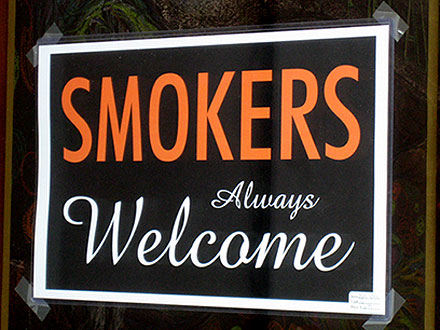 he place, I did not know that this Parisian-style salon that made it's own Artisan cigarettes and hung a sign in the door that read, "Smokers ALWAYS welcome," was opening just days after the Smoking Ban hit Chicago's reknown restaurants and vintage, cult diners. I also wasn't aware that McGearty's was owned by a giant tobacco company, and had been getting an eyebrow raise from the media. So, when I was a pproached by a Washington Post reporter, I didn't imagine I would soon be a voice for the Smoking Party in news syndication all over the country.
  The article, "Tobacco Lounge Blows Smoke in The Face of Chicago's New Ban," quotes me sounding like a clueless DePaul Freshman that had accidentally stumbled into
he place, I did not know that this Parisian-style salon that made it's own Artisan cigarettes and hung a sign in the door that read, "Smokers ALWAYS welcome," was opening just days after the Smoking Ban hit Chicago's reknown restaurants and vintage, cult diners. I also wasn't aware that McGearty's was owned by a giant tobacco company, and had been getting an eyebrow raise from the media. So, when I was a pproached by a Washington Post reporter, I didn't imagine I would soon be a voice for the Smoking Party in news syndication all over the country.  The article, "Tobacco Lounge Blows Smoke in The Face of Chicago's New Ban," quotes me sounding like a clueless DePaul Freshman that had accidentally stumbled into
 the campsite of the Indie elite, holding meetings on how to proceed in some culture war. I might as well have said, "Oh, I thought this was Starbucks," withsome journalistic description of a giggle. She made me sound like a food in two half sentences. But, still, I was a young musician in a salon, fighting for my right to smoke cigarettes, just like the man in Le Cafe de Flore. For the world to see. Maybe my coolest, hippest, most visible moment. But soon after, I acquired asthma, and had to give up entirely what was once my most favorite, favorite thing.
I've been a nonpracticing smoker since March of 2007. And I miss it. And I hate that I will never smoke in a Parisian cafe. But they can't ban me from the smoky, dimly lit rooms of my memory. And they ban me from the luminous, celebrity studded smoking section of my dreams.


30 December 2007
The Golden Suicides: Folie a Deux, Amour Foux, or Victims of the Scientology Mafia?
 So, it's the talk of high society New York, or at least it was last month. Two deaths. Rich, beautiful power couple going mad. Talks of The Church of Scientology intimidating and harrassing the victims. It all somehow has to do with Beck. Read on.
In the most recent issue of Vanity Fair, I found a noir-narrative article about a "New York art world double suicide!" that captivated me, and started me researching the two victims, Theresa Duncan and Jeremy Blake, a well-known couple for their eccentricism and uncommon closeness. (They were obsessed with one another.) In photographs together, the pair of digital artists look casual, cool and in possession of shared secrets the rest of the world might never uncover. I found them immediately charming and vulnerable.I had to know who went first.
The article documents the couple's meeting, their mad love and equally successful yet turbulent careers, and a timeline of events leading up to their deaths. It sounds too romantic to be true. Theresa Duncan takes a bottle of pills with her favorite champagne one night in the church rectory apartment they share on the lower east side of New York. Jeremy Duncan, seemingly stunned and emotionally empty following his lover's suicide, goes missing for weeks. Speculation all over the New York papers and art blogs suggests he has run away, or been killed by the Church of Scientology (hard to explaine, see article). But then Blake is seen walking into the ocean. His body turns up days later, and a double suicide of literary proportions is complete. But there are many questions unanswered, and Nancy Jo Sales' controversially dramatic, first-hand (she knew Duncan personally) account, "The Golden Suicides," attempts to tap into the dark, troubled world these two creatives spun for themselves in the years before their deaths.
The story is quite twisted. Duncan and Blake are equally disgusting and vulnerable, almost likable. Some intriguing elements include their involvement with indie rock star Beck, and his Scientology faith, which plays a major role in their unraveling. Also, the reader might find themselves familiar with both Duncan and Blake's work both in the late 20th century and early 21st in digital art, giving this story a connective feel. Adding to the intimacy of this piece is the mention of Theresa Duncan's blog, which is still available to read on the internet. The Wit of the Staircase is a rabbit hole into Duncan's wonderland, andnow a richly layered memorial, not only to Duncan and her lover, but to the world of dark, ironic and daring art of the late 20th century that Blake and Duncan were a part of, an art that seems unable to transfer into this new century and its obsession with transcendence and positive energy. Duncan and Blake were still operating in the angst of the their generation, and finding it difficult to be heard. In this article, their voices whisper clear instruction and inspiration from the grave.
 Duncan, her ghost blog and peculiar biography-- even just the look in her eye, directly influenced me to start a blog, and keep a meter, a record going of the art and the influences that speak to me becauase, I find that I too am tuned into a moment past. I am oh so familiar with mental chaos and torment, and can relate to Blake and Duncan as part of "our wandering kind." in the lyric of Laura Veirs. Moving from Seattle to New York to Los Angeles to New York, the two seemed to sniff out scene and set up their nest right in the flow of culture, where they felt most alive. Unfotunately, the high frequency or maybe the weight of their artistic tasks made them susceptible to fracture, and things went very wrong. See for yourself. You can find the classically written mystery-feature article here.
Blake and Duncan, evidently posing for something.

So, you can see, something isn't quite right...
Anna Zemánková
 Anna Zemánková (1908-1988) was a Czech homemaker who started making artwork like this piece in her 50's for personal pleasure and meditation, and never pursued a career in art. Considered an Intuit or "Outsider" artist, Zemankova gained popularity in the 21st century, as interest in "spontaneous" art rose. Zemanjova is said to have created her lush, mixed-media artwork in an altered state or trance. I feel that the imagery evokes a darker psychology even with it's juicy, sweet color pallete. I find Zemankova to be in conversation with the literary queens of madhousewifery in the same era who used their artform as an outlet for repressed emotional anxiety.
I have been researching Zemankova on the internet very recently, but I first came across her work in the June 2003 issue of the Chicago Review poetry journal. I quickly tore the fold-out of Zwmbankova's work from the journal pages, and held them as a keepsake for years. Now and then, I would put the wrinkled, torn images into frames and hang them on my wall. The pieces have always resonated with me, and I've taken them out many times over the years to stare at the layers and delicious color formulas. I've always felt that this woman's work was tuned specifically to my aesthetic craving. And it's not often that this feeling rises like a greedy child with it's arms extended, fingers closing and opening. My mouth waters for these pieces, and maybe I'll never know really what they communicate to me. But I think they are a visual representation of my tactile, sensual desires. I adore them. Find out more about Anna Zemánková here


Subscribe to:
Posts (Atom)


